


Which Sensor Direction Fits Your Low-Light, USB3.0, MIPI, or Embedded Vision Project?
When selecting a Sony STARVIS 2 camera module for your device, IMX678 and IMX585 are two common 4K-class sensor options. Both can be used for security monitoring, traffic vision, industrial inspection, robotics, embedded vision, and low-light imaging projects.
However, they are not the same choice.
For your project, the right decision should not be based only on the sensor model. It should also consider interface type, lens size, view angle, distortion, focusing distance, PCB structure, module size, and mechanical integration.
SincereFirst can support different IMX678 and IMX585 camera module directions, including USB camera modules, MIPI camera modules, compact board-level modules, wide-angle FPC modules, and separated structure camera modules.
Find Your Camera Module Direction First
| Your Project Needs | Recommended Direction | Why It Matters |
|---|---|---|
| Low-light imaging and lower distortion | IMX585 USB Camera Module | Better for fixed-view monitoring, inspection, and optical image quality priority. |
| Compact 4K imaging with easier host connection | IMX678 USB3.0 Camera Module | Better for USB3.0 output, compact board structure, and embedded hardware testing. |
| Wide-angle vision and FPC integration | IMX678 MIPI Camera Module | Better for robotics, embedded platforms, and board-level integration. |
| Flexible internal layout | IMX678 Separated Board Structure | Better when the camera head and processing board need different positions inside the device. |

1. Quick Answer: IMX585 or IMX678?
Choose IMX585 USB Camera Module if your project needs:
- Lower distortion optical design.
- More controlled view angle.
- Stable fixed-view imaging.
- Low-light monitoring or inspection.
- USB camera module integration.
Choose IMX678 USB3.0 Camera Module if your project needs:
- Compact 4K imaging.
- USB3.0 output.
- 38mm x 38mm board-level structure.
- 1cm to infinity imaging distance.
- Embedded vision or machine vision testing.
Choose IMX678 MIPI Camera Module if your project needs:
- Wide-angle embedded vision.
- FPC board-level integration.
- Direct connection to an embedded platform.
- Robotics, smart devices, or compact hardware design.
The key point is simple:
IMX585 is better when low-light image quality and optical control matter more.
IMX678 is better when compact 4K integration, USB3.0, MIPI, or flexible structure matter more.
2. IMX678 vs IMX585: Key Differences for Camera Module Projects
| Selection Factor | IMX678 Camera Module | IMX585 Camera Module | What It Means for Your Project |
|---|---|---|---|
| Sensor Type | Sony STARVIS 2 CMOS sensor | Sony STARVIS 2 CMOS sensor | Both are suitable for advanced 4K imaging projects. |
| Optical Format | 1/1.8 type | 1/1.2 type | IMX585 needs more optical space; IMX678 is easier for compact structure. |
| Pixel Size | 2.0μm x 2.0μm | 2.9μm x 2.9μm | IMX585 has more low-light margin. |
| Interface Direction | USB3.0 / MIPI direction | USB camera module direction | Choose based on host platform and integration method. |
| Structure Direction | Compact PCB / FPC / separated structure | Larger optical structure / low-distortion lens direction | Choose based on device space and lens requirement. |
| Better For | Embedded vision, robotics, portable devices | Monitoring, inspection, low-light fixed-view imaging | Choose by real application, not by sensor model only. |
3.IMX585 USB Camera Module: For Low-Distortion Fixed-View Imaging
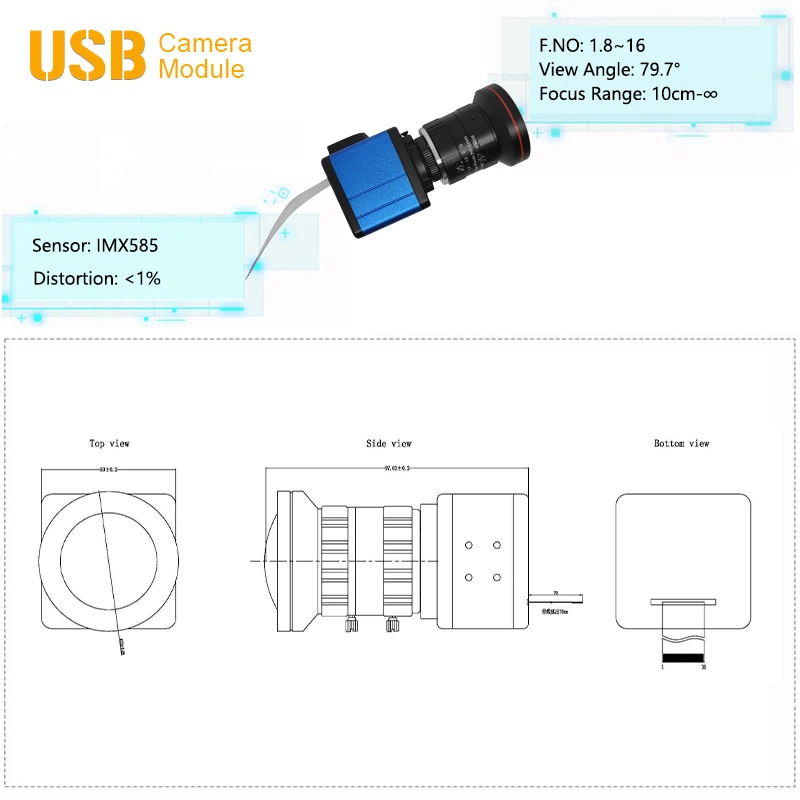
This IMX585 USB camera module direction is more suitable when your device needs a controlled view angle, lower distortion, and stable fixed-view imaging. It can be evaluated for inspection, positioning, monitoring, and other applications where optical accuracy matters more than wide-angle coverage.
| Item | Available Direction |
|---|---|
| Sensor | IMX585 |
| Interface | USB camera module |
| View Angle | 19.7° |
| Distortion | <1% |
| Focus Range | 10cm to infinity |
| F.NO | 1.8–16 |
| Better For | Fixed-view inspection, positioning, monitoring, low-distortion imaging |
Need a low-distortion IMX585 USB direction for your device? Send your working distance, FOV, lens size, module space, and host platform for evaluation.
4. IMX678 USB3.0 Camera Module: For Compact 4K Board-Level Integration
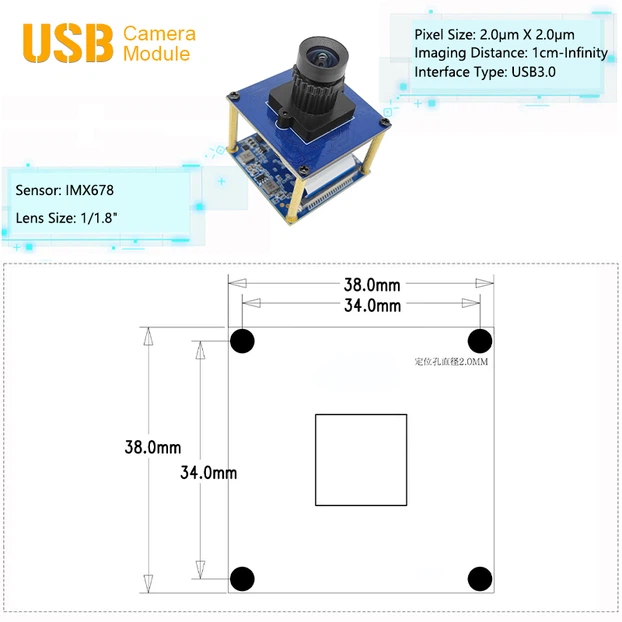
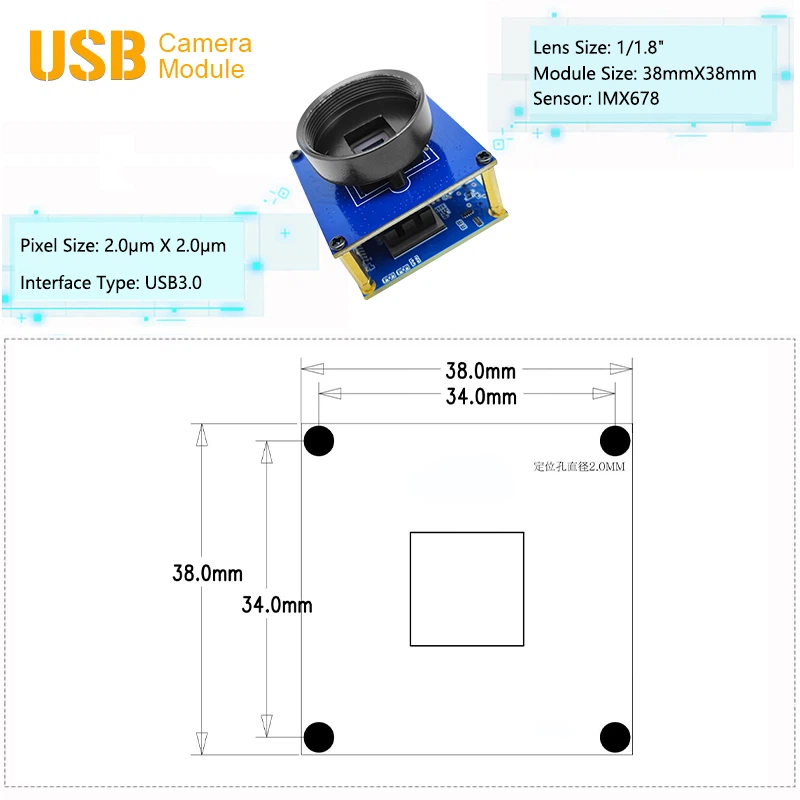
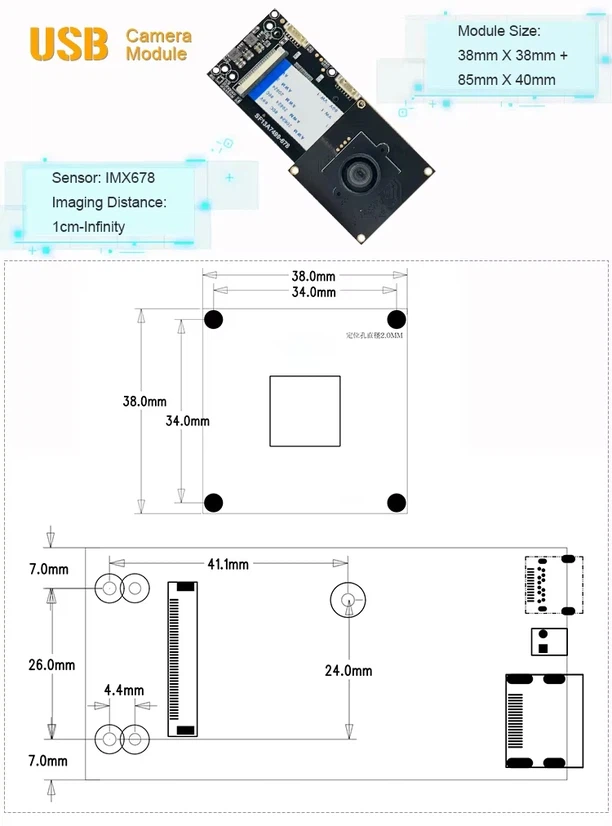
This IMX678 USB3.0 direction is more suitable when your project needs compact 4K imaging, USB3.0 output, and easier host-side testing. It can be considered for embedded vision, compact machine vision, AI vision terminals, robotics, and portable imaging devices.
| Item | Available Direction |
|---|---|
| Sensor | IMX678 |
| Pixel Size | 2.0μm x 2.0μm |
| Interface | USB3.0 |
| Lens Size | 1/1.8 inch |
| Imaging Distance | 1cm to infinity |
| Board Structure | 38mm x 38mm |
| Separated Structure | 38mm x 38mm + 85mm x 40mm |
| Better For | Compact 4K imaging, embedded vision, USB3.0 testing |
| Choose This Structure | When Your Device Needs |
|---|---|
| 38mm x 38mm compact board | Standard compact board-level integration. |
| 38mm x 38mm + 85mm x 40mm separated structure | More flexible internal layout between camera head and processing board. |
Need an IMX678 USB3.0 module for compact 4K imaging? Send your board space, cable routing, interface, FOV, and host platform for evaluation.
5. IMX678 MIPI Camera Module: For Wide-Angle Embedded Vision and FPC Integration
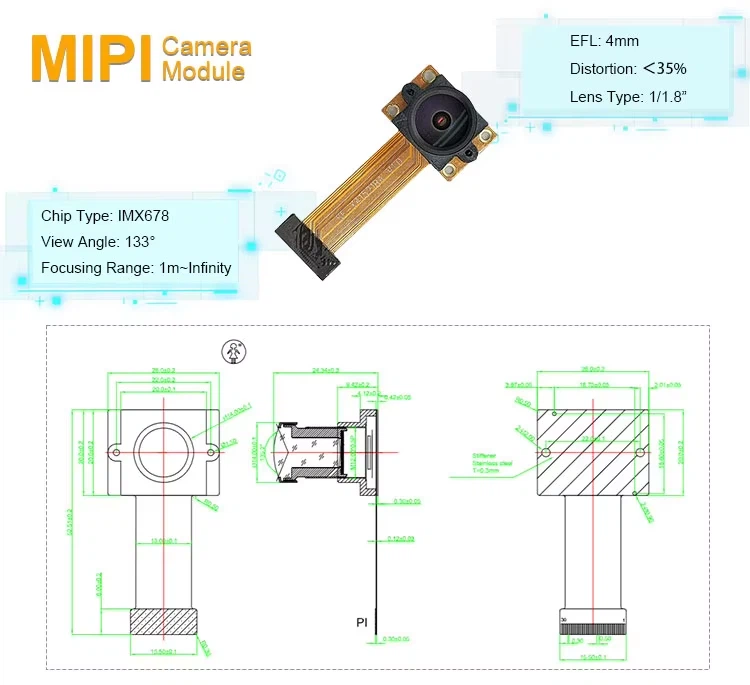
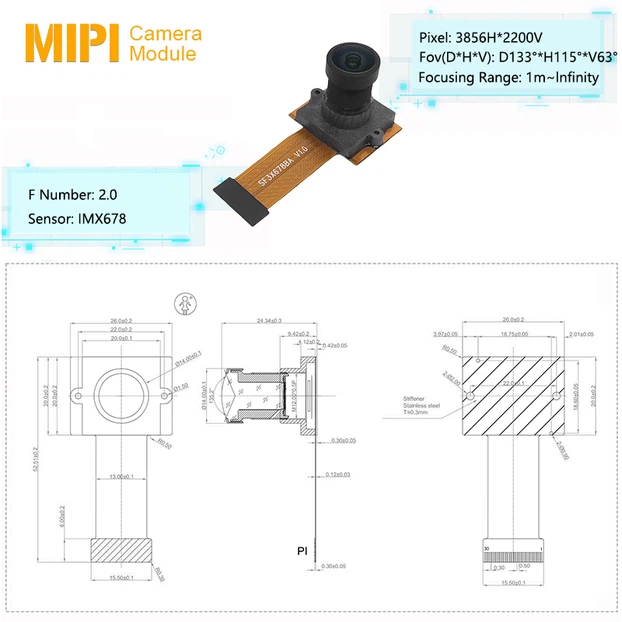
This IMX678 MIPI direction is more suitable when your project needs wide-angle imaging, flexible FPC connection, and direct board-level integration. It can be evaluated for robotics, embedded AI vision, compact industrial equipment, smart devices, and space-limited hardware platforms.
| Item | Available Direction |
|---|---|
| Sensor | IMX678 |
| Interface | MIPI camera module |
| Lens Type | 1/1.8 inch |
| View Angle | 133° |
| FOV | D/H/V 133° / 115° / 63° |
| EFL | 4mm |
| F.NO | 2.0 |
| Focusing Range | 1m to infinity |
| Pixel Output Information | 3856 x 2200 |
| Better For | Wide-angle embedded vision, robotics, FPC integration |
Before sampling this MIPI direction, your engineering team should confirm FPC length, connector type, pin definition, MIPI lane configuration, host platform, driver support, lens height, and image tuning requirements.
Need an IMX678 MIPI direction for an embedded platform? Send your host platform, FPC space, connector requirement, FOV, and working distance for evaluation.
6. How to Choose the Right Camera Module Direction?
| If Your Project Needs | Choose This Direction | What to Confirm Before Sampling |
|---|---|---|
| Low-light and lower distortion | IMX585 USB Camera Module | FOV, distortion, working distance, lens size. |
| Compact 4K with USB3.0 | IMX678 USB3.0 Camera Module | Board space, USB connection, host platform, cable routing. |
| Wide-angle embedded vision | IMX678 MIPI Camera Module | FPC length, connector, pin definition, driver support. |
| Flexible internal structure | IMX678 separated board structure | Camera head position, board position, cable direction. |
| Other STARVIS / STARVIS 2 requirements | Custom camera module direction | Sensor, lens, interface, PCB/FPC, mechanical design. |
7. Sony STARVIS and STARVIS 2 Camera Module Customization Support
SincereFirst can evaluate camera module customization based on your project structure, including:
- Sensor selection, including Sony STARVIS / STARVIS 2 and other CMOS sensor platforms.
- USB, MIPI, FPC, endoscope, or project-based camera module structure.
- Lens, FOV, aperture, distortion, focus distance, and lens holder.
- Fixed focus or VCM autofocus design.
- PCB size, FPC shape, FPC length, connector position, and pin definition.
- Cable routing, mechanical matching, and assembly structure.
- SDK, firmware, 3D files, Gerber, layout, 2D drawings, and other project-stage documents.
The final camera module should match your optical design, mechanical space, host platform, software environment, cable routing, assembly process, and production requirements.
8. Key Factors Before Sampling
Before selecting the final IMX678, IMX585, or other Sony STARVIS camera module, your project should confirm the following points.
1. Lighting Environment
If your device works in outdoor, night, or weak-light conditions, IMX585 may provide more low-light image quality margin.
If your device works in indoor, controlled-light, or compact embedded environments, IMX678 may be easier to integrate.
2. Interface
USB3.0 is useful when your project needs easier host connection and higher data transmission than standard USB2.0 directions.
MIPI is suitable when your project needs compact embedded integration, FPC connection, and direct board-level development.
3. Lens and View Angle
A narrow view angle and low distortion design may be better for fixed-view inspection or positioning.
A wide-angle MIPI module may be better for robotics, monitoring, and embedded vision devices that need larger scene coverage.
4. Module Structure
A compact 38mm x 38mm board may be suitable for standard integration.
A separated board structure may be considered when your device needs more flexible internal layout.
An FPC module may be better when the camera head and main board need to be placed in different positions.
5. Mechanical and Production Requirements
A camera module used in a real device must match not only image quality requirements, but also mechanical design, connector position, assembly method, reliability testing, and production consistency.
9. FAQ
Is IMX585 better than IMX678?
Not always. IMX585 is more suitable when your project needs stronger low-light performance or lower-distortion optical design. IMX678 is more suitable when your project needs compact 4K integration, USB3.0 output, MIPI connection, or flexible structure design.
Is IMX678 suitable for USB3.0 camera modules?
Yes. Based on the provided SincereFirst product information, IMX678 can be used in USB3.0 camera module designs with compact board structures and 1/1.8-inch lens matching.
Is IMX678 suitable for MIPI camera modules?
Yes. IMX678 MIPI camera module directions can support FPC structure, wide-angle lens design, and embedded vision integration.
When should I choose an IMX585 USB camera module?
You can consider an IMX585 USB camera module when your project needs low-light imaging, lower distortion, fixed-view monitoring, or inspection-type imaging.
When should I choose an IMX678 MIPI camera module?
You can consider an IMX678 MIPI camera module when your project needs wide-angle vision, compact FPC structure, embedded platform integration, or board-level camera design.
What customization information should I provide?
For faster evaluation, you can provide your application, target resolution, interface, FOV, lens size, working distance, module size, PCB/FPC space, connector requirement, cable direction, host platform, and project stage.
Can IMX678 replace IMX585 in low-light projects?
Not always. IMX678 can support compact 4K imaging, but IMX585 may provide more low-light margin because of its larger optical format and pixel size. If your project has limited space but still needs low-light imaging, lens and structure evaluation are required.
Should I choose USB3.0 or MIPI for an IMX678 camera module?
Choose USB3.0 when your project needs easier host connection and development testing. Choose MIPI when your project needs direct board-level integration, FPC structure, and embedded platform connection. The final choice should be evaluated with host platform, bandwidth, cable routing, and software requirements.
11. Conclusion
IMX678 and IMX585 are both strong Sony STARVIS 2 sensors for 4K camera module projects, but they serve different project priorities.
IMX585 is more suitable for projects that need stronger low-light imaging, lower distortion lens design, and fixed-view optical performance.
IMX678 is more suitable for compact 4K embedded vision, USB3.0 camera module integration, MIPI FPC camera module design, robotics, portable devices, and space-limited camera module projects.
For OEM and embedded vision projects, the best choice should not be based only on the sensor model. It should be evaluated together with interface, lens, FOV, distortion, focusing range, PCB/FPC structure, cable design, software compatibility, mechanical space, and production requirements.
Not sure whether IMX678, IMX585, USB3.0, MIPI, compact board, or separated structure is better for your device?
Send us your application, interface, FOV, lens size, module size, host platform, and project requirements. SincereFirst can help evaluate a suitable camera module solution for your project.


