


Quick Answer
Not every vision system needs high resolution or color.
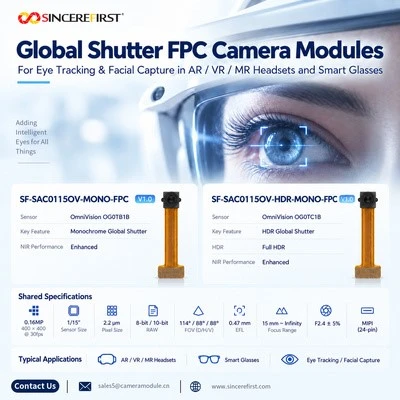
The SF-SAC0115OV-MONO-FPC combines a compact monochrome global shutter sensor, wide field of view and NIR-enhanced imaging, making it suitable for embedded devices that prioritize motion capture, tracking and low-power vision.
Why Some Vision Tasks Need Speed and Simplicity Instead of More Pixels
For recognition, photography or detailed inspection, higher resolution can be valuable.
But tracking tasks are different.
A system may only need to determine:
Where an object is
How it is moving
Whether a position has changed
Where a feature or marker appears in the frame
In these cases, increasing resolution can also increase image data, processing load and system requirements without necessarily improving the task itself.
The SF-SAC0115OV-MONO-FPC uses a 400 × 400 monochrome imaging format with global shutter, providing a different direction for compact systems where motion and position matter more than color or fine image detail.
Key Advantages of the SF-SAC0115OV-MONO-FPC
1. Global Shutter for Moving Targets
Rolling-shutter cameras capture different image rows at slightly different times.
When the target or camera is moving, this can introduce geometric distortion that may affect tracking or position analysis.
A global shutter captures the frame simultaneously, making it more suitable for applications involving:
Moving objects
Rapid position changes
Camera movement
Motion or feature tracking
For these applications, accurate frame geometry may be more valuable than simply increasing resolution.
2. Monochrome and NIR Enhancement for Machine Vision Tasks
The module uses a monochrome sensor and supports NIR-enhanced imaging.
For systems that do not need color information, monochrome imaging can provide a more focused solution for detecting brightness, shape, position and movement.
NIR capability also provides an imaging direction for systems using near-infrared illumination, especially where visible-light appearance is not the primary requirement.
This can be useful for sensing and tracking functions that need to operate independently of normal color imaging.
3. Low Resolution Reduces Unnecessary Image Data
The camera provides 400 × 400 resolution at up to 30FPS.
For a detailed imaging application, this would be limited.
For tracking or sensing, however, lower image data can be an advantage when the host system does not need a large image.
It can help reduce:
Data bandwidth
Image processing workload
Memory requirements
Overall system complexity
This makes the module particularly relevant when the device needs usable visual information rather than a high-resolution photograph.
4. Wide Field of View for Tracking a Larger Area
The lens provides approximately D114° / H88° / V88° field of view.
A wider viewing area helps when the target may move across the scene instead of remaining in one narrow position.
This can provide more room for:
Motion tracking
Position sensing
Gesture detection
Environmental awareness
The goal is to keep the target inside the usable image area for more of its movement.
5. 15mm to Infinity Depth of Field for Flexible Detection Distance
The optical specification lists a focusing range of 15mm to infinity, together with a 0.47mm focal length and F2.4 aperture.
This wide depth-of-field characteristic is useful when the system needs to detect objects across different distances without continuous autofocus.
It also avoids adding autofocus hardware where the vision task does not require it.
Typical Applications
Eye and Feature Tracking
For tracking tasks, the system often needs position and movement information rather than a high-resolution color image.
Global shutter, monochrome imaging and NIR enhancement make this type of camera suitable for evaluating eye, facial-feature or other feature-tracking applications.
AR/VR and Wearable Vision
Wearable devices have strict limitations on camera size, power consumption and processing resources.
A compact low-resolution global shutter camera can provide motion or tracking information without requiring the same bandwidth as a high-resolution RGB camera.
Robotics and Position Tracking
Robots may use dedicated tracking cameras alongside their main imaging cameras.
The tracking camera can focus on motion, position or navigation-related information while another camera handles detailed scene imaging.
Compact Machine Vision and Sensing Devices
For devices that only need to detect movement, position, shape or presence, a small monochrome global shutter camera may provide a more efficient solution than a higher-resolution color camera.
When Should You Consider This Camera Module?
The SF-SAC0115OV-MONO-FPC is more relevant when your project needs:
Global shutter for motion capture
Monochrome rather than color imaging
NIR-enhanced vision
Wide scene coverage
Low image-data requirements
Compact camera integration
Simple tracking or sensing rather than detailed photography
If the application needs fine texture, small text or detailed identification, a higher-resolution camera would usually be more appropriate.
FAQ
1. Is 400 × 400 resolution enough for a vision application?
It depends on the task.
If the system mainly needs position, movement, shape or feature information, high resolution may not be necessary.
If the application needs fine visual details, another higher-resolution sensor should be considered.
2. Why use global shutter for tracking?
Global shutter captures the entire frame at the same moment.
This helps reduce motion-related geometric distortion, which can be important when the system analyzes where an object is or how it moves.
3. Why choose monochrome instead of a color camera?
If color information is not needed, a monochrome camera can focus on intensity, shape and feature information.
It can also be useful in systems designed around near-infrared illumination.
4. What is the value of the wide field of view?
A wider field of view gives moving targets more space to remain inside the image.
This can be useful for tracking, gesture sensing and other applications where target position changes frequently.
5. What information should I provide before evaluating this module?
It is helpful to provide:
Tracking or sensing task
Target size
Target speed
Working distance
Visible or NIR illumination
Available camera space
Host platform and MIPI requirements
These details help determine whether the resolution, shutter type, optics and interface match the actual vision task.
Need a Compact Camera for Motion or Tracking?
If your device does not need a detailed color image but does need reliable motion, position or feature information, share your target, working distance, movement speed and host platform with us.
We can help evaluate whether the SF-SAC0115OV-MONO-FPC or another global shutter camera configuration is more suitable for your project.


