


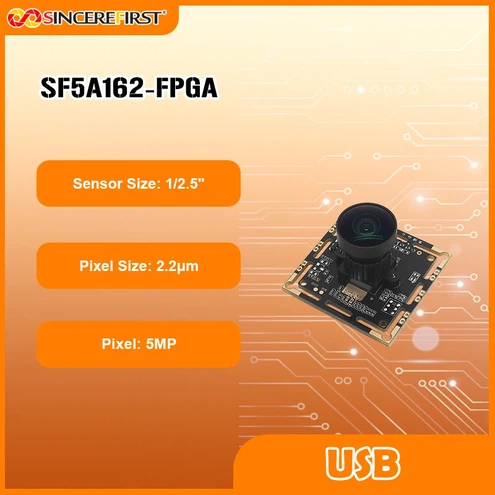
With the development of intelligent transportation systems, image capture devices are required to meet the needs of accurately capturing dynamic targets, clearly restoring details, and stably adapting to complex environments. Traditional rolling shutter cameras tend to produce the "jello effect" when shooting high-speed objects. In contrast, the USB camera module equipped with 5MP resolution, 2560×1440@60FPS high frame rate, and global shutter technology has become an ideal choice for intelligent traffic surveillance due to its parameter adaptability.
Global Shutter and 60FPS High Frame Rate
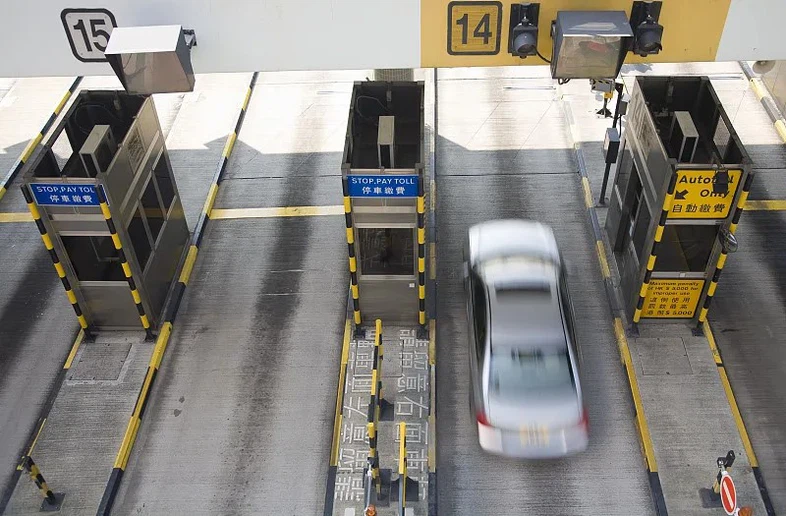
The core challenge of intelligent traffic surveillance is undistorted capture of high-speed moving targets. Vehicles on urban arterial roads and highways travel at speeds of 60-120 km/h; traditional rolling shutters easily cause image jello effects, and low frame rates (e.g., 30FPS) may miss instantaneous traffic events.
The module's global shutter technology captures light signals of the entire frame simultaneously through "one-time full-frame exposure"; combined with 2560×1440@60FPS output, it balances the clarity of 2.5K resolution and the ability to record trajectories at 60 frames per second. In terms of data, 60FPS captures one frame every 16.7 milliseconds, which is a 100% improvement in capture accuracy compared to 30FPS (one frame every 33.3 milliseconds). When a vehicle travels at 120 km/h (33.3 m/s), the displacement per frame is only 0.55 meters-far less than the 1.11 meters of 30FPS-enabling clear restoration of vehicle posture and details.
In practical applications, its license plate recognition accuracy exceeds 99.2% during the day and reaches 97.5% at night; 60FPS also records events such as running red lights and continuous lane changes in full, providing reliable evidence for law enforcement and avoiding frame skipping issues.
Large Pixels and Wide Focus Range
Intelligent traffic surveillance needs to balance long-distance panoramic views and close-range details, while also adapting to day-night light differences. The module's hardware parameters address this need in a targeted manner:
It adopts a 1/2.5-inch sensor and 2.2μm×2.2μm large pixels. The light input per pixel is approximately 150% higher than that of cameras with small pixels of the same class. In low-light environments (e.g., under 5lux streetlights), it can reduce noise, clearly distinguish vehicle colors and models, and avoid blurry images at night.
At the same time, the 1cm~Infinity ultra-wide focus range expands application scenarios: close-range focusing at 1cm can capture bumper scratches and tire patterns, while long-range focusing can monitor panoramic views of intersections 50-100 meters away; the manual focusing design eliminates the need for lens replacement, reducing maintenance costs.
In specific scenarios, long-range focusing can be used at highway service area entrances to count traffic flow and ease congestion; at accident scenes at urban intersections, close-range focusing can capture collision details, providing a basis for liability determination.
External Trigger and UVC Protocol
Intelligent traffic surveillance needs to connect with traffic lights, electronic police, and AI servers to form a "capture-analysis-judgment-law enforcement" closed loop. The module's functional design adapts to system integration requirements.
First, the external trigger function enables precise timed shooting by receiving signals from external devices (e.g., traffic light controllers, inductive loops). For example, when an inductive loop detects a vehicle crossing the stop line, it triggers the camera to capture images synchronously-reducing invalid storage by 90% compared to the traditional "recording + frame extraction" mode. With a response delay of less than 10ms, it can synchronize with the moment the red light turns on, ensuring the legality of law enforcement evidence.
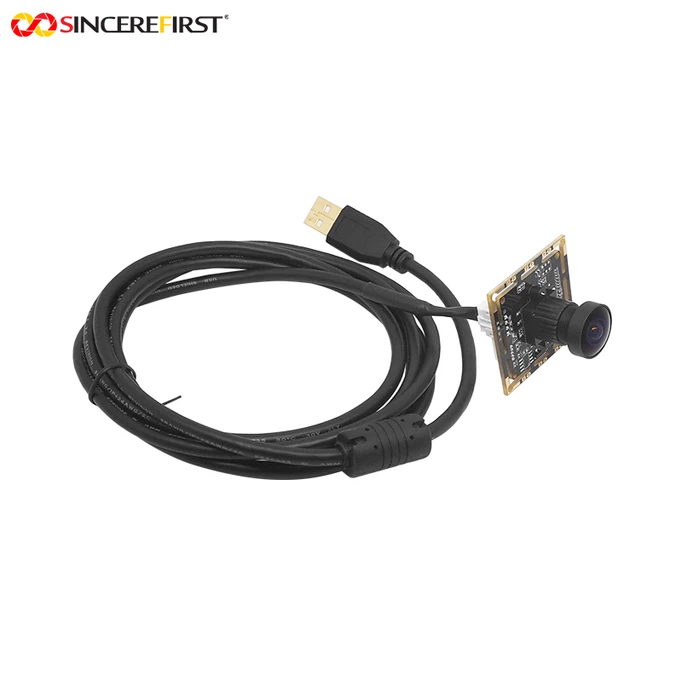
Second, USB2.0 + UVC protocol supports plug-and-play functionality without additional drivers, enabling direct connection to AI servers running Windows or Linux systems. After configuration, it can realize the automation of "image transmission-automatic recognition-result push". Compared with traditional industrial cameras, the integration cycle is shortened by 50%, labor costs are reduced by 30%, making it suitable for rapid deployment in small and medium-sized cities.
In addition, its compact size of 38mm×38mm allows easy integration into surveillance devices; the SMT (ROHS) process ensures stable operation in high-temperature environments (up to 60℃ in equipment enclosures in summer) and high humidity (during rainy seasons), with a mean time between failures (MTBF) exceeding 50,000 hours, reducing maintenance frequency.
Future Development Prospects
As intelligent transportation upgrades toward "intelligence and connectivity", the application value of high-frame-rate global shutter cameras will be further released, especially showing broad prospects in the integration with cutting-edge technologies:
Integration with 5G: The 2560×1440@60FPS video stream is transmitted in real time via 5G's high bandwidth and low latency. Traffic command centers can remotely monitor cross-regional traffic flow and accident scenes, quickly formulate diversion plans, and shorten rescue response times.
Integration with AI: High-quality, non-blurred images provide accurate training data for deep learning algorithms, driving vehicle recognition accuracy to exceed 99.5% and extending the advance warning time for dangerous behaviors from 1-2 seconds to 3-5 seconds.
V2X (Vehicle-to-Everything) Applications: As a core roadside perception device, it can supplement the blind spots of autonomous vehicle sensors. In heavy rain, it can identify non-motor vehicles running red lights and push warnings via the V2X system to help vehicles avoid risks.

Conclusion
The module solves high-speed motion blur through global shutter + 60FPS, covers multi-scenario light and distance needs via large pixels + wide focus range, and enables efficient system connection through external trigger + UVC protocol-forming a capability closed loop of "dynamic capture-detail restoration-system integration" and playing a significant role in intelligent traffic surveillance.
In terms of value, it not only improves the accuracy of surveillance data and reduces deployment costs but also supports future V2X and autonomous driving road condition perception. It has become a core hardware for upgrading intelligent traffic surveillance from "visualization" to "precision", injecting momentum into the efficiency and safety of traffic management.


