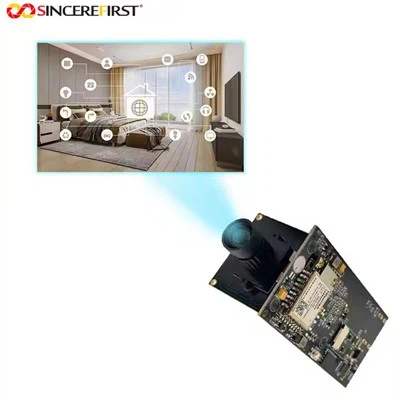
In the realm of modern technology, the demand for advanced camera modules with diverse capabilities has been on a steady rise. As a supplier of Dvp Camera Modules, I often encounter inquiries about the support for face recognition in our products. In this blog post, I will delve into the details of whether our Dvp Camera Modules support face recognition, exploring the technical aspects, potential applications, and the overall feasibility of integrating this feature.
Understanding Dvp Camera Modules
Before we discuss face recognition, it's essential to understand what Dvp Camera Modules are. Dvp, or Digital Video Port, is a standard interface used for transferring video data between a camera sensor and a host device. Our Dvp Camera Modules are designed to provide high - quality image and video capture, with various resolutions and features to meet different user needs.
We offer a range of Dvp Camera Modules, such as the GC0309 DVP Camera Module, 5MP OV5640 Camera Module For Raspberry Pi, and OV5640 5MP ESP32 Cam DVP Camera Module. These modules are equipped with different sensors and chipsets, which play a crucial role in determining their capabilities, including the potential for face recognition.
Technical Feasibility of Face Recognition in Dvp Camera Modules
Face recognition is a complex process that involves several steps, including face detection, feature extraction, and matching. For a Dvp Camera Module to support face recognition, it needs to have certain technical specifications.
Image Resolution and Quality
High - resolution images are essential for accurate face recognition. Our Dvp Camera Modules offer a range of resolutions, from low - resolution options suitable for basic applications to high - resolution modules capable of capturing detailed facial features. For example, the 5MP OV5640 Camera Module For Raspberry Pi provides a relatively high resolution, which can capture clear images of faces, making it more suitable for face recognition tasks.
Processing Power
Face recognition algorithms require significant processing power to perform tasks such as feature extraction and matching in real - time. While the camera module itself may not have the built - in processing power for full - fledged face recognition, it can be paired with a powerful host device. For instance, when used with a Raspberry Pi or an ESP32 board, the combined system can handle the computational requirements of face recognition algorithms.
Sensor Sensitivity
The sensor in the Dvp Camera Module needs to be sensitive enough to capture facial details in different lighting conditions. Our camera modules are designed with sensors that have good sensitivity, allowing them to capture clear images even in low - light environments. This is crucial for face recognition, as accurate feature extraction relies on clear and well - lit facial images.
Applications of Face Recognition with Dvp Camera Modules
If our Dvp Camera Modules are capable of supporting face recognition, there are numerous applications in various industries.
Security and Surveillance
In security systems, face recognition can be used to identify authorized personnel and detect intruders. Our Dvp Camera Modules can be installed in entrances, corridors, and other areas of a building to monitor and recognize faces. For example, the OV5640 5MP ESP32 Cam DVP Camera Module can be integrated into a security system to provide real - time face recognition and alert the security personnel in case of unauthorized access.
Access Control
Face recognition can be used for access control in offices, schools, and other facilities. Instead of using traditional access cards or passwords, employees or students can simply have their faces scanned at the entrance. Our Dvp Camera Modules can be used to capture facial images and match them against a pre - registered database, providing a more convenient and secure access control solution.
Retail and Marketing
In the retail industry, face recognition can be used to analyze customer demographics and behavior. Our Dvp Camera Modules can be installed in stores to capture the faces of customers, and the data can be used to understand customer preferences and improve marketing strategies.
Challenges and Limitations
While our Dvp Camera Modules have the potential to support face recognition, there are also some challenges and limitations.
Lighting Conditions
As mentioned earlier, lighting conditions can significantly affect the accuracy of face recognition. In extreme lighting conditions, such as direct sunlight or very low light, the quality of the captured images may be compromised, leading to inaccurate face recognition results.
Algorithm Complexity
Developing and implementing accurate face recognition algorithms can be complex. It requires a significant amount of data for training and fine - tuning the algorithms. Additionally, different face recognition algorithms may have different performance characteristics, and choosing the right algorithm for a specific application can be challenging.
Privacy Concerns
Face recognition technology raises privacy concerns, as it involves collecting and analyzing personal facial data. As a supplier, we are committed to ensuring that our products comply with relevant privacy regulations and that the data collected is used in a responsible and secure manner.
Conclusion
In conclusion, our Dvp Camera Modules have the potential to support face recognition, but it depends on several factors, including the specific module, the host device, and the implementation of the face recognition algorithm. Our GC0309 DVP Camera Module, 5MP OV5640 Camera Module For Raspberry Pi, and OV5640 5MP ESP32 Cam DVP Camera Module offer the necessary image quality, sensor sensitivity, and compatibility with host devices to enable face recognition applications.


If you are interested in exploring the possibility of using our Dvp Camera Modules for face recognition or other applications, we invite you to contact us for a detailed discussion. We can provide you with more information about our products, technical support, and customized solutions to meet your specific requirements.
References
- "Face Recognition Technology: A Comprehensive Review" by Y. Sun, et al.
- "Image Processing for Face Recognition" by R. Jain, et al.
- "Security and Privacy Implications of Face Recognition Systems" by A. Narayanan, et al.