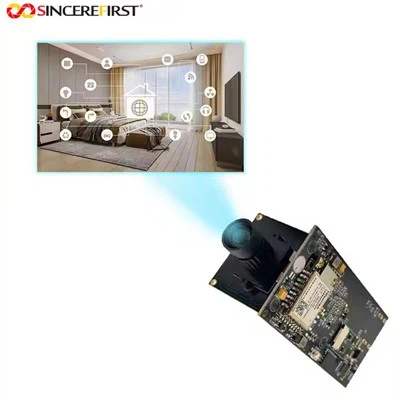
In the dynamic landscape of imaging technology, auto focus modules stand at the forefront of innovation, continuously evolving to meet the ever - increasing demands of diverse industries. As a dedicated auto focus module supplier, I am thrilled to explore the latest technologies in this field and share insights that can benefit businesses and enthusiasts alike.
Piezoelectric Actuators: Precision in Motion
One of the most significant advancements in auto focus modules is the adoption of piezoelectric actuators. These actuators operate on the principle of the piezoelectric effect, where certain materials generate an electric charge in response to applied mechanical stress, and conversely, deform when an electric field is applied.
Piezoelectric actuators offer several advantages over traditional voice coil motors (VCMs). Firstly, they provide extremely high precision. The ability to move the lens with sub - micron accuracy allows for sharp and clear images even in challenging conditions. For example, in machine vision applications where detecting small defects or precise measurements are crucial, the high precision of piezoelectric actuators ensures that every detail is captured accurately.
Secondly, piezoelectric actuators are known for their fast response times. They can adjust the focus in a matter of milliseconds, which is essential for applications such as high - speed photography and video recording. In action sports photography or industrial inspection systems that need to capture fast - moving objects, this rapid focusing capability can make a significant difference.
Our 8 Megapixel IMX179 Af Sensor Machine Vision System Camera Module utilizes piezoelectric actuators to deliver exceptional image quality and fast focusing performance. This module is ideal for machine vision tasks, including quality control in manufacturing, robotics, and surveillance.
Liquid Lens Technology: Flexibility and Adaptability
Liquid lens technology is another revolutionary development in auto focus modules. A liquid lens consists of a liquid - filled chamber with an adjustable shape. By applying an electric current, the surface tension of the liquid can be changed, which in turn alters the curvature of the lens and adjusts the focus.
One of the key benefits of liquid lens technology is its flexibility. Unlike traditional solid - state lenses, liquid lenses can change their focal length continuously and smoothly. This makes them well - suited for applications where a wide range of focusing distances is required, such as in mobile devices and endoscopes.
In mobile phones, liquid lens technology can provide a more natural and seamless focusing experience. It can quickly switch between focusing on nearby objects, like a flower in a macro shot, and distant landscapes. Moreover, liquid lenses are compact and lightweight, which is a significant advantage for mobile device manufacturers who are constantly striving to reduce the size and weight of their products.


Our 5MP USB Camera Auto Focus Lens 30FPS Camera Module incorporates liquid lens technology to offer a versatile and high - performance auto focus solution. This module is suitable for a variety of applications, including webcams, video conferencing systems, and small - scale surveillance.
Hybrid Auto Focus Systems: Combining the Best of Both Worlds
Hybrid auto focus systems are emerging as a popular choice in the market. These systems combine different focusing technologies, such as phase - detection autofocus (PDAF) and contrast - detection autofocus (CDAF), to achieve the best possible focusing performance.
PDAF is known for its speed. It can quickly estimate the distance to the subject by comparing the phase of light rays entering different parts of the image sensor. This makes it ideal for capturing fast - moving objects. On the other hand, CDAF is highly accurate. It analyzes the contrast in the image to determine the sharpest focus point. By combining these two technologies, hybrid auto focus systems can take advantage of the speed of PDAF and the accuracy of CDAF.
In digital cameras and high - end smartphones, hybrid auto focus systems can provide a superior focusing experience. They can quickly lock onto the subject and then fine - tune the focus for optimal sharpness. This results in clear and well - focused images, whether you are taking a portrait, a landscape, or a sports shot.
Our Sony IMX179 8MP Auto Focus USB Camera Module features a hybrid auto focus system. This module is designed for applications that require both speed and accuracy in focusing, such as professional photography, live streaming, and industrial imaging.
Artificial Intelligence and Machine Learning in Auto Focus
The integration of artificial intelligence (AI) and machine learning (ML) into auto focus modules is opening up new possibilities. AI and ML algorithms can analyze the scene in real - time and predict the optimal focus settings based on various factors, such as the type of subject, lighting conditions, and depth of field.
For example, in portrait photography, an AI - powered auto focus module can detect the face of the subject and ensure that it is in sharp focus while blurring the background for a more artistic effect. In industrial inspection, AI algorithms can identify different types of objects and adjust the focus accordingly to detect defects or measure dimensions accurately.
These algorithms can also learn from previous focusing experiences. Over time, they can improve their performance and adapt to different scenarios more effectively. This self - learning capability makes auto focus modules more intelligent and reliable.
Future Trends and Outlook
Looking ahead, the future of auto focus modules is filled with exciting possibilities. We can expect to see further miniaturization of components, which will enable the development of even smaller and more portable camera modules. This will be particularly beneficial for applications such as wearable devices and drones.
The integration of 3D sensing technology with auto focus modules is also on the horizon. 3D sensing can provide more accurate depth information, which can enhance the focusing performance, especially in complex scenes. This will open up new opportunities in augmented reality (AR), virtual reality (VR), and 3D mapping applications.
In addition, the demand for higher resolution and better image quality will continue to drive innovation in auto focus technology. As sensors become more advanced, auto focus modules will need to keep up to ensure that every pixel is in sharp focus.
Conclusion
As an auto focus module supplier, we are committed to staying at the forefront of these technological advancements. Our products, such as the 8 Megapixel IMX179 Af Sensor Machine Vision System Camera Module, 5MP USB Camera Auto Focus Lens 30FPS Camera Module, and Sony IMX179 8MP Auto Focus USB Camera Module, are designed to meet the diverse needs of our customers.
If you are interested in exploring our auto focus modules or have specific requirements for your project, we invite you to contact us for procurement and further discussions. Our team of experts is ready to assist you in finding the best solution for your imaging needs.
References
- "Advances in Piezoelectric Actuators for Auto Focus Modules", Journal of Optical Engineering
- "Liquid Lens Technology: A New Frontier in Imaging", Proceedings of the International Symposium on Imaging Science and Technology
- "Hybrid Auto Focus Systems: Combining Speed and Accuracy", IEEE Transactions on Image Processing
- "Artificial Intelligence in Auto Focus: Current Trends and Future Prospects", Machine Learning in Computer Vision Journal