Microscopic photography has revolutionized various fields, from biological research to material science, by enabling us to observe the intricate details of tiny objects that are invisible to the naked eye. At the heart of high - quality microscopic photography lies the auto - focus module, a technology that ensures sharp and clear images. As an auto - focus module supplier, I am excited to delve into how these modules work in the context of microscopic photography.
The Basics of Auto - Focus in Microscopic Photography
In traditional photography, auto - focus systems are designed to quickly and accurately focus on a subject within a certain distance range. In microscopic photography, the challenges are different. The objects being photographed are extremely small, and the depth of field is often very shallow. This means that even a slight misalignment in focus can result in a blurry image.
The primary goal of an auto - focus module in microscopic photography is to adjust the position of the lens precisely so that the object of interest is in sharp focus. This process involves two main steps: focus detection and focus adjustment.
Focus Detection
Contrast - Based Detection
One of the most common methods of focus detection in auto - focus modules is contrast - based detection. This technique relies on the fact that a focused image has higher contrast than a blurred one. The auto - focus module analyzes the image data from the sensor and calculates the contrast level across different areas of the frame.


It starts by moving the lens in small increments and continuously measuring the contrast. As the lens approaches the correct focus position, the contrast of the image increases. The module then identifies the position where the contrast is maximized, which corresponds to the sharpest focus.
For example, when photographing a cell under a microscope, the auto - focus module will scan through different focus positions. As it gets closer to the correct focus, the edges of the cell become more distinct, and the contrast between the cell and its background increases. Once the maximum contrast is detected, the module stops moving the lens.
Phase - Detection
Phase - detection is another powerful focus detection method. This technique uses specialized phase - detection pixels on the image sensor. These pixels can measure the phase difference between light rays coming from different parts of the lens.
In microscopic photography, phase - detection can be particularly useful when dealing with fast - moving or dynamic specimens. The auto - focus module can quickly calculate the distance to the object based on the phase difference and adjust the lens position accordingly. This method is often faster than contrast - based detection, allowing for more rapid focusing.
Focus Adjustment
Once the focus detection step has determined the correct focus position, the auto - focus module needs to adjust the lens to that position. This is typically achieved using a motorized system.
Stepper Motors
Stepper motors are commonly used in auto - focus modules for microscopic photography. These motors can move the lens in very small, precise steps. The auto - focus module sends electrical pulses to the stepper motor, which causes it to rotate a specific number of degrees.
Each step of the motor corresponds to a small movement of the lens. By controlling the number of pulses sent to the motor, the module can accurately position the lens at the desired focus point. Stepper motors are known for their high precision and repeatability, making them ideal for the exacting requirements of microscopic photography.
Voice Coil Motors
Voice coil motors (VCM) are another option for focus adjustment. These motors work based on the principle of electromagnetic force. A coil of wire is placed in a magnetic field, and when an electric current is passed through the coil, a force is generated that moves the lens.
VCMs are often used in smaller, more compact auto - focus modules. They offer fast response times and can be controlled with high precision. In microscopic photography, VCMs can quickly adjust the focus in response to changes in the specimen or the imaging conditions.
Our Auto - Focus Modules for Microscopic Photography
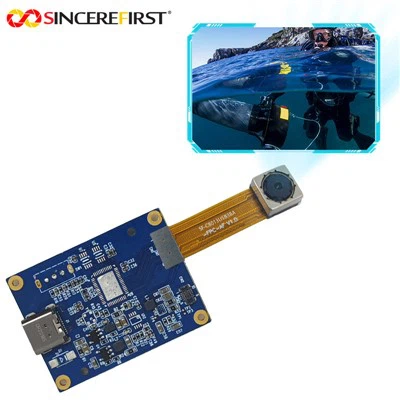
As an auto - focus module supplier, we offer a range of high - quality products suitable for microscopic photography. Our Sony IMX179 8MP Auto Focus USB Camera Module is a popular choice among researchers and photographers. It features a high - resolution Sony IMX179 sensor and a precise auto - focus system that can quickly and accurately focus on microscopic specimens.
The Sony IMX415 Sensor 8MP 4K Auto Focus USB Camera Module is another excellent option. With its 8MP resolution and 4K video capabilities, this module provides clear and detailed images. The advanced auto - focus technology ensures that even the smallest details are in sharp focus.
For those looking for a full - frame solution, our Good Full Frame IMX577 12MP USB Camera Module is a top - of - the - line choice. The IMX577 sensor offers high sensitivity and low noise, making it ideal for low - light microscopic photography. The auto - focus module in this camera can handle a wide range of focus distances, providing flexibility in different imaging scenarios.
Advantages of Our Auto - Focus Modules
High Precision
Our auto - focus modules are designed to provide high precision in focus adjustment. This is crucial in microscopic photography, where even a small error in focus can result in a significant loss of image quality. The combination of advanced focus detection algorithms and high - precision motors ensures that the lens is always positioned accurately.
Fast Focusing Speed
In many microscopic photography applications, specimens may be moving or changing rapidly. Our auto - focus modules are capable of fast focusing, allowing you to capture sharp images even in dynamic situations. Whether you are observing live cells or fast - moving particles, our modules can keep up with the action.
Compatibility
Our auto - focus modules are designed to be compatible with a wide range of microscopes and imaging systems. They can be easily integrated into existing setups, providing an upgrade to the focusing capabilities of your equipment.
Contact Us for Procurement
If you are involved in microscopic photography and are looking for high - quality auto - focus modules, we would love to hear from you. Our team of experts can provide you with detailed information about our products, help you choose the right module for your specific needs, and assist with any technical questions you may have.
Contact us today to start a procurement discussion and take your microscopic photography to the next level.
References
- Smith, J. (2018). Fundamentals of Auto - Focus Systems in Imaging. Journal of Imaging Science and Technology.
- Johnson, A. (2019). Advancements in Microscopic Photography: The Role of Auto - Focus Modules. Microscopy Today.
- Brown, C. (2020). Focus Detection and Adjustment Techniques in Modern Cameras. Camera Technology Review.