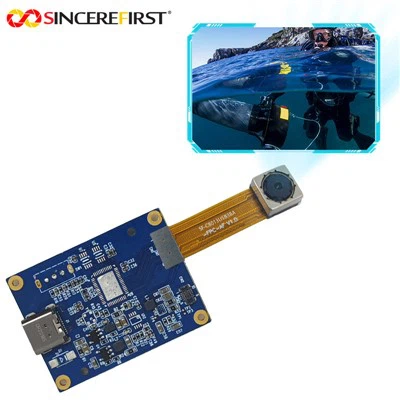
As a supplier of CMOS camera modules, I often encounter questions from customers about the modulation transfer function (MTF) of these modules. The MTF is a crucial concept in understanding the performance of a CMOS camera module, and in this blog, I'll delve into what it is, why it matters, and how it impacts the overall quality of the images captured by our products.
Understanding the Modulation Transfer Function
The modulation transfer function is a measure of how well a camera system can transfer contrast from the object being imaged to the final image. In simpler terms, it describes the ability of a camera module to reproduce fine details in an image. When light passes through the various components of a camera, such as the lens and the image sensor, it can be affected by factors like diffraction, aberrations, and noise. These factors can cause a loss of contrast and sharpness in the image, and the MTF helps us quantify this loss.
Mathematically, the MTF is defined as the ratio of the contrast in the image to the contrast in the object, as a function of spatial frequency. Spatial frequency refers to the number of cycles of a pattern (such as a series of black and white bars) per unit distance. For example, a high spatial frequency corresponds to a pattern with many closely spaced bars, while a low spatial frequency corresponds to a pattern with fewer, more widely spaced bars.
The MTF is typically expressed as a curve, with spatial frequency on the x - axis and the modulation transfer ratio on the y - axis. The modulation transfer ratio ranges from 0 to 1, where 1 represents perfect contrast transfer (i.e., the image has the same contrast as the object), and 0 represents no contrast transfer (i.e., the image is completely featureless).
Why the MTF Matters
The MTF is an important metric for several reasons. Firstly, it provides a comprehensive way to evaluate the optical performance of a camera module. By looking at the MTF curve, we can quickly assess how well the module will perform at different levels of detail. A camera module with a high MTF at high spatial frequencies is capable of capturing fine details with good contrast, while a module with a low MTF at high frequencies will produce images that appear blurry or lacking in sharpness.
Secondly, the MTF can help us compare different camera modules. When choosing a camera for a particular application, such as surveillance, machine vision, or mobile photography, we need to consider the specific requirements of the application. For example, a surveillance camera may need to capture fine details at a distance, so a module with a high MTF at high spatial frequencies would be preferred. On the other hand, a mobile camera used mainly for social media photos may not require such high - resolution performance, and a module with a lower MTF at high frequencies but better performance at lower frequencies (where most of the subject matter lies) may be sufficient.
Finally, the MTF can be used to optimize the design of a camera module. By analyzing the MTF curve, we can identify areas where the optical performance can be improved. For example, if the MTF is low at high spatial frequencies, we may need to improve the lens design to reduce aberrations or choose a higher - quality image sensor with better resolution.
Factors Affecting the MTF of a CMOS Camera Module
Several factors can affect the MTF of a CMOS camera module. These include:
Lens Quality
The lens is one of the most critical components in a camera module, and its quality has a significant impact on the MTF. A high - quality lens with low aberrations and good optical correction will have a higher MTF at all spatial frequencies compared to a low - quality lens. Different types of lenses, such as prime lenses and zoom lenses, also have different MTF characteristics. Prime lenses, which have a fixed focal length, generally have better MTF performance than zoom lenses, which need to cover a range of focal lengths.
Image Sensor Characteristics
The image sensor is another important factor. The pixel size, pixel pitch, and the number of pixels on the sensor all affect the MTF. Smaller pixel sizes can potentially capture higher spatial frequencies, but they may also be more susceptible to noise, which can reduce the MTF. Additionally, the sensor's fill factor (the ratio of the light - sensitive area of a pixel to the total pixel area) can impact the MTF, as a higher fill factor allows more light to be captured, resulting in better contrast.
Noise
Noise in the camera system can also degrade the MTF. Electronic noise from the image sensor, amplifier, and other components can reduce the contrast in the image, especially at low light levels. Thermal noise, in particular, can be a problem in long - exposure applications, as it can cause random fluctuations in the pixel values, making the image appear grainy and reducing the MTF.
Optical Aberrations
Optical aberrations, such as spherical aberration, chromatic aberration, and astigmatism, can cause a loss of contrast and sharpness in the image, leading to a lower MTF. These aberrations occur when light rays passing through the lens do not converge at a single point, resulting in a blurred or distorted image.
Measuring the MTF of a CMOS Camera Module
There are several methods for measuring the MTF of a CMOS camera module. One common method is to use a test target with a known pattern of black and white bars. The camera is then pointed at the test target, and an image is captured. The contrast in the image is measured at different spatial frequencies, and the MTF curve is calculated based on the ratio of the contrast in the image to the contrast in the test target.
Another method is to use a Fourier transform - based approach. In this method, the image of the test target is Fourier - transformed, and the MTF is calculated from the Fourier spectrum of the image. This method is more complex but can provide more accurate results, especially for complex patterns.
Examples of CMOS Camera Modules and Their MTF Performance
As a supplier, we offer a wide range of CMOS camera modules, each with its own MTF characteristics. For example, the Omnivision OV50A40 OV50AB40 OB50C40 Image Camera Sensor Module is known for its high - resolution performance. It has a high MTF at high spatial frequencies, making it suitable for applications that require the capture of fine details, such as industrial inspection and high - end surveillance.
The Sony IMX586 IMX686 IMX766 Stacked CMOS Sensor OIS Camera Module is another popular choice. These modules have excellent MTF performance across a wide range of spatial frequencies, thanks to their advanced sensor technology and high - quality lenses. They are widely used in mobile phones and other consumer electronics for their ability to capture sharp, high - contrast images.
Our OV Camera Module series also offers a good balance between cost and performance. These modules have a decent MTF at mid - to - high spatial frequencies, making them suitable for a variety of applications, including security cameras and automotive vision systems.
Conclusion
In conclusion, the modulation transfer function is a vital concept in understanding the performance of a CMOS camera module. It provides a quantitative measure of how well a camera can capture fine details and reproduce contrast in an image. By considering the factors that affect the MTF, such as lens quality, image sensor characteristics, noise, and optical aberrations, we can optimize the design of our camera modules to meet the specific needs of our customers.


If you are in the market for a CMOS camera module and want to learn more about the MTF performance of our products, or if you have specific requirements for your application, we invite you to contact us for a detailed discussion. Our team of experts is ready to assist you in choosing the right camera module for your needs.
References
- Smith, J. (2018). Optical Imaging and Photography. Wiley.
- Jones, A. (2020). CMOS Image Sensors: Technology and Applications. Springer.
- Brown, C. (2019). Fundamentals of Digital Photography. Prentice Hall.