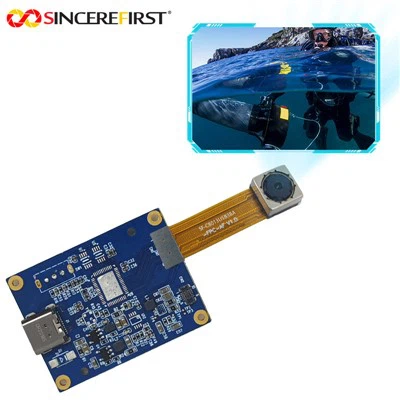
Hey there! As a supplier of USB 3.0 camera modules, I've seen firsthand how lighting conditions can have a huge impact on image quality. In this blog post, I'm gonna break down how different lighting setups can affect the performance of our USB 3.0 camera modules, and I'll also share some real - world examples to help you understand better.
Let's start with bright, natural daylight. This is like the holy grail of lighting for most camera modules, including our USB 3.0 ones. When there's plenty of sunlight, colors look vibrant and true - to - life. The high - resolution sensors in our 12MP IMX577 Fixed Focus USB Camera Module shine in these conditions. The 12 - megapixel resolution allows for sharp details, and the wide dynamic range can handle the contrast between bright and shaded areas quite well. You can see every little nuance, whether it's the texture of a leaf or the grain on a wooden surface.
However, even in daylight, there are some challenges. Direct sunlight can create harsh shadows. If you're trying to capture an object with a lot of depth, those shadows can hide details. Our camera modules are designed to mitigate this to some extent. The advanced algorithms in the image processing unit work to balance the exposure, so you don't end up with over - exposed highlights and under - exposed shadows.
Now, let's move on to indoor artificial lighting. Fluorescent lights are a common choice in offices and commercial buildings. But they have a bit of a problem - they flicker. This flickering can cause banding or rolling shutter effects in the images taken by our camera modules. Our Machine Vision Sony IMX415 STARVIS 8MP USB 3.0 Camera Module has some features to deal with this. For example, it can detect the frequency of the flickering lights and adjust the exposure time accordingly. This way, most of the time, you can get clean, stable images.
On the other hand, incandescent lights tend to have a warm color temperature. This means the images will have a bit of an orange - yellow tint. Our camera modules come with White Balance (WB) settings that can be adjusted manually or set to automatic mode. In auto WB, the camera analyzes the color in the scene and tries to make the whites look white, regardless of the lighting source. So, even under incandescent lights, the colors in your images will look fairly accurate.
Dimly lit environments are another story. Low light can be a real headache for any camera. But our USB 3.0 camera modules are equipped with high - sensitivity sensors. Take the 8MP IMX179 USB3.0 Separate Camera Module for example. Its sensor can capture more light in low - light conditions, which reduces the amount of image noise. Image noise looks like grainy dots in the picture and can really ruin the quality.
To further enhance the performance in low light, we've also incorporated some dark - frame subtraction techniques. This involves taking a picture with the shutter closed to measure the background noise and then subtracting that from the actual image. This helps in getting a cleaner, more detailed image even when there's not much light around.
In backlit situations, where the main light source is behind the subject, it can be tricky. The subject might end up looking like a silhouette. Our camera modules have a feature called High - Dynamic - Range (HDR) imaging. HDR combines multiple exposures of the same scene to capture both the bright and dark areas at once. So, if you're taking a picture of a person with a bright sunset behind them, you can see the details on the person's face as well as the colorful sky in the background.
Let's talk about how all these technical aspects translate into real - world applications. For industrial inspection, the lighting in a factory can vary from bright spots under large overhead lights to dimmer areas in storage corners. Our USB 3.0 camera modules are reliable in these changing light conditions. They can accurately detect defects on products, whether it's a scratch on a metal surface or a flaw in a plastic part.
In the field of security and surveillance, lighting is often inconsistent. You might have areas that are well - lit during the day but pitch - black at night. Our camera modules can adjust to these changes. They can capture clear images of people and objects during the day, and when night falls, their low - light performance ensures that you can still see what's going on.
In the realm of robotics and machine vision, our camera modules rely on stable and accurate image data. The ability to adapt to different lighting conditions is crucial. For example, in a warehouse where robots are moving around, the lighting can be affected by the movement of the robots themselves, as well as the position of the goods. Our camera modules can provide consistent image quality, which is essential for the robots to navigate and perform their tasks.


So, if you're in the market for a USB 3.0 camera module that can perform well in various lighting conditions, we've got you covered. Whether it's for industrial use, security, or any other application, our products are designed to meet your needs. If you have any questions or want to discuss your specific requirements, feel free to reach out. We're always happy to help you find the perfect camera module for your project and have a chat about procurement.
References
- Camera Module Technology Handbook
- Lighting and Image Quality Research Papers