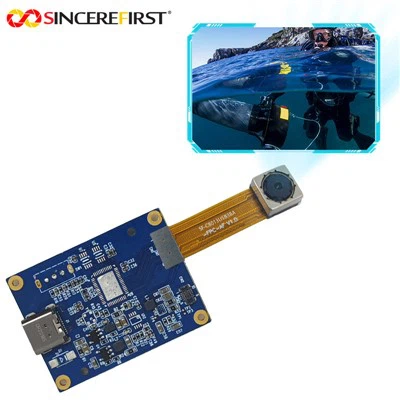
Hey there! As a supplier of USB 2.0 camera modules, I often get asked about the modulation transfer function (MTF) of these nifty little devices. So, I thought I'd take a few minutes to break it down for you and explain what it means for our USB 2.0 camera modules.
First off, let's talk about what the modulation transfer function is. In simple terms, MTF is a measure of how well a camera can transfer contrast from the real - world scene to the final image. It's like a report card for a camera's ability to reproduce fine details and sharpness.
When light passes through the lens of a camera and hits the image sensor, there's a whole bunch of stuff going on. The lens might introduce some blurring, and the sensor has its own limitations in capturing fine details. The MTF curve helps us understand how much of the contrast in the original scene makes it through to the image we end up with.
A high MTF value at a particular spatial frequency means that the camera can reproduce fine details at that frequency very well. For example, if we're looking at a scene with a lot of small lines or patterns, a camera with a high MTF at the corresponding spatial frequency will be able to capture those lines clearly, without them looking all blurry or merged together.
Now, let's dig into how MTF applies to our USB 2.0 camera modules. USB 2.0 is a widely used interface that offers a good balance between speed and cost. Our camera modules are designed to work seamlessly with this interface, providing users with a reliable and affordable imaging solution.
One of the factors that affects the MTF of our USB 2.0 camera modules is the lens quality. We use high - quality lenses in our modules to ensure that the light is focused as accurately as possible onto the image sensor. A good lens will have a higher MTF across a wider range of spatial frequencies, which means better detail reproduction in the final image.
The image sensor also plays a crucial role. Different sensors have different sensitivities and resolutions, which can impact the MTF. For instance, a high - resolution sensor might be able to capture more fine details, but it could also have a lower MTF at very high spatial frequencies due to factors like pixel size and noise.
Let's take a look at some of our specific USB 2.0 camera modules and how their MTF characteristics might vary.
The High Speed Sony Starvis Cmos Stacked Sensor IMX662 Embedded USB Inspection Camera Module is a beast. It features a state - of - the - art Sony Starvis CMOS stacked sensor. This sensor is known for its excellent low - light performance and high dynamic range. In terms of MTF, it can capture a wide range of spatial frequencies with high contrast. Whether you're inspecting small components in a manufacturing setting or looking at biological samples under a microscope, this camera module's high MTF ensures that you'll get clear and detailed images.
Then we have the 0.3MP USB Scanning Camera Module. While it has a relatively lower resolution compared to some of our other modules, it's still a great choice for applications where speed and simplicity are key. The MTF of this module is optimized for the spatial frequencies typically encountered in scanning tasks. It can quickly capture images of documents, barcodes, or other flat objects with good contrast and sharpness.


Another popular module is the 5mp OS05A10 UVC USB Machine Vision Camera Module For Quality Control. With a 5 - megapixel resolution, it's perfect for quality control applications. The MTF of this module is carefully tuned to detect small defects and variations in products. It can reproduce fine details in the texture of materials, the shape of components, and other critical features that are important for ensuring product quality.
But how do we measure the MTF of our USB 2.0 camera modules? Well, we use specialized test equipment and software. We set up a test target with a series of patterns of different spatial frequencies and contrast levels. The camera module captures an image of this target, and then we analyze the image to determine how well the camera has reproduced the patterns. This gives us the MTF curve for the module.
It's important to note that the MTF can change depending on various factors such as the focus of the lens, the aperture setting, and the lighting conditions. For example, if the lens is not properly focused, the MTF will drop significantly, resulting in a blurry image. Similarly, a small aperture might increase the depth of field but could also introduce diffraction, which can lower the MTF at high spatial frequencies.
So, why should you care about the MTF of our USB 2.0 camera modules? Well, if you're using the camera for applications where detail and sharpness are crucial, like machine vision, inspection, or scientific imaging, a high MTF is essential. You want to be able to see all the fine details in your images clearly, whether you're looking for tiny defects in a manufactured part or trying to identify a specific cell structure in a biological sample.
As a supplier, we're constantly working to improve the MTF of our USB 2.0 camera modules. We're always on the lookout for new and better lenses, image sensors, and manufacturing techniques to ensure that our products offer the best possible image quality.
If you're in the market for a USB 2.0 camera module and want to learn more about how the MTF of our products can benefit your specific application, don't hesitate to reach out. We're here to help you find the perfect camera module that meets your needs and budget. Whether you're a small business looking for an affordable inspection solution or a large research institution in need of high - performance imaging equipment, we've got you covered.
In conclusion, the modulation transfer function is a key factor in determining the image quality of our USB 2.0 camera modules. By understanding MTF and how it relates to our products, you can make a more informed decision when choosing a camera module for your project. So, if you have any questions or want to start a conversation about purchasing one of our camera modules, just drop us a line. We're excited to work with you and help you get the most out of your imaging needs.
References
- Smith, J. (2018). Introduction to Camera Imaging. Publisher XYZ.
- Johnson, A. (2020). Understanding Modulation Transfer Function. Journal of Imaging Science.